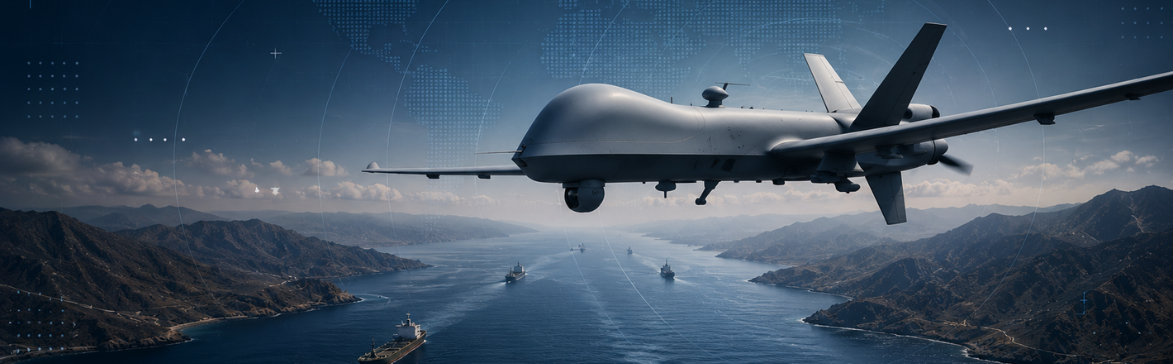
An Unmanned Aerial Vehicle (UAV) is an aircraft that operates without a pilot on board, controlled either remotely by a human operator or autonomously through onboard systems. UAVs range from small inspection quadcopters to long-endurance fixed-wing platforms used for intelligence, surveillance, and reconnaissance (ISR). The term is often used interchangeably with “drone,” though “Unmanned Aircraft System (UAS)” is the broader regulatory term covering the aircraft, ground control station, and data link.
Across maritime, defense, and commercial operations, UAVs extend the sensing perimeter of ports, naval units, and offshore assets. They do so by supporting vessel surveillance, persistent ISR, dark activity investigation, emissions monitoring, search and rescue, and inspection of platforms and pipelines.
The idea of an unmanned aircraft predates powered flight itself, but the modern UAV emerged from military experimentation in the early 20th century and matured into a mainstream defense, commercial, and maritime tool over the following hundred years.
The first recognizable UAVs were radio-controlled target drones developed during and after the First World War. The Aerial Target, a British radio-controlled aircraft designed by Dr Archibald Low, became the first drone to fly under control when it was tested in March 1917.
UAVs found their first sustained operational role as reconnaissance platforms. First flown in 1962, the reconnaissance Firebee saw extensive service in Southeast Asia during the Vietnam War. The Tadiran Mastiff and the IAI Scout, the first Israeli battlefield UAVs, introduced in the 1970s, proved that small, real-time-video UAVs could deliver tactical intelligence at a scale that crewed aircraft could not, shaping subsequent Western tactical UAV development, most directly the U.S. Navy’s Pioneer, which became the U.S. military’s first widely deployed tactical UAV.
The General Atomics RQ-1 Predator entered U.S. service in 1995 and became the platform that normalized armed, long-endurance UAVs in defense operations. Its armed variant, the MQ-1, conducted the first UAV strike missions in the early 2000s and established the medium-altitude, long-endurance (MALE) category as a core ISR capability for modern militaries.