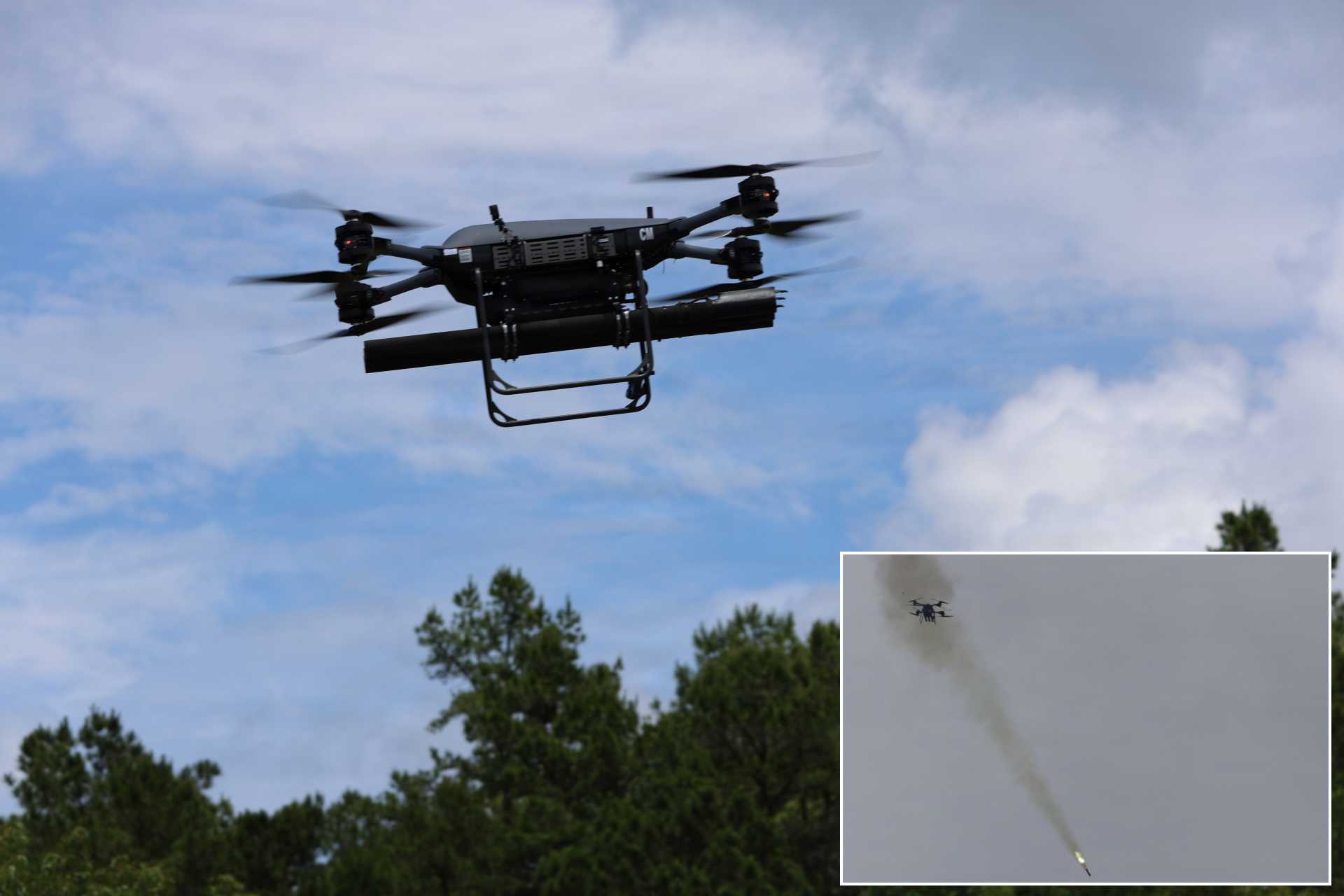
The U.S. Army and American defense industry partners have successfully demonstrated a TRV-150 unmanned aerial vehicle armed with a three-shot APKWS (Advanced Precision Kill Weapon System) laser-guided rocket launcher during live firing tests at Fort Rucker, Alabama, on May 20, 2026. The trial highlights a growing effort to equip battalion-level units with precision-strike capability, enabling commanders to engage targets rapidly without relying on manned aircraft or higher-echelon fire support.
By integrating proven 70 mm laser-guided rockets onto a logistics drone, the system combines resupply and attack functions in a single unmanned platform. The capability reflects a broader shift toward armed autonomous systems that can extend battlefield reach, increase responsiveness, and deliver precision effects closer to the tactical edge.Related Topic: U.S. Military Eyes Armed UGV With 30mm Cannon And Coyote Stinger Missiles For Counter Drone Warfare
TRV-150 tactical resupply drone armed with a three-shot APKWS launcher launches a laser-guided 70 mm rocket during flight testing at Fort Rucker, Alabama, on May 20, 2026, demonstrating a new battalion-level precision-strike capability.”(Picture source: U.S. Department of War/Defense)
The live firing test paired Service Engineering Company's TRV-150 cargo drone with a three-round APKWS (Advanced Precision Kill Weapon System) rocket launcher developed by BAE Systems FalconWorks. Conducted in cooperation with multiple Army aviation and modernization organizations, the event evaluated the feasibility of transforming a logistics unmanned aerial vehicle into a multi-role combat asset capable of delivering precision effects against ground and aerial targets.
The TRV-150 is currently fielded as a logistics and resupply unmanned aerial vehicle for the U.S. Army and U.S. Marine Corps. Designed to transport up to 150 pounds of cargo, the aircraft supports distributed operations by delivering ammunition, fuel, medical supplies, and critical equipment to forces operating beyond traditional supply lines. Its modular architecture provides onboard power, data interfaces, and payload integration points, enabling rapid adaptation to mission-specific requirements.
The integration of APKWS significantly expands the aircraft's operational role. Originally developed as a precision-guidance kit for Hydra 70 rockets, the APKWS converts unguided 70 mm rockets into laser-guided munitions capable of engaging targets with high accuracy while minimizing collateral damage. The weapon has become a widely deployed precision-strike solution across U.S. and allied forces due to its relatively low cost compared with larger guided missiles.
Published on 5/31/2026