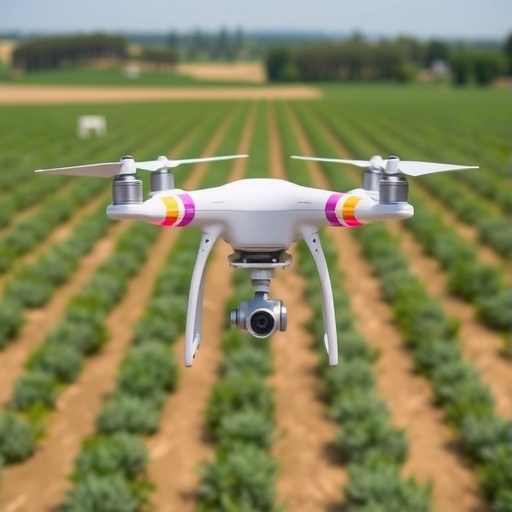
In the field of environmental science and agricultural resource management, the ability to accurately identify and map areas at risk of contributing to water pollution has long relied on cutting-edge, yet costly, technologies. A recent breakthrough led by researchers at Penn State University heralds a transformative shift in this domain, unveiling a novel, cost-effective approach that harnesses the power of drones combined with photogrammetry to generate precise, high-resolution spatial maps traditionally dependent on more expensive methods like LiDAR.
For decades, LiDAR (Light Detection and Ranging) has been the gold standard for producing detailed elevation and landscape models crucial for understanding how water flows across agricultural terrains. LiDAR works by emitting laser pulses from airborne platforms to measure terrain elevations with exceptional accuracy, creating detailed digital elevation models that help pinpoint hydrologically sensitive zones’regions where water accumulates or flows rapidly, thus posing a high risk of runoff. However, the acquisition, processing, and deployment of LiDAR data can be prohibitively expensive and logistically challenging, particularly in rural or dynamically changing agricultural landscapes.
Challenging this paradigm, the Penn State research team implemented a drone-based system utilizing Structure from Motion (SfM) photogrammetry, an innovative imaging technology that reconstructs three-dimensional models by analyzing numerous overlapping two-dimensional photographs taken from varying angles. This imagery-based approach enables the generation of detailed elevation maps with remarkable precision, rivaling the quality of LiDAR outputs but at a fraction of the cost and with enhanced accessibility.
At the heart of this breakthrough lies the ability of small unmanned aerial vehicles (UAVs), commonly referred to as drones, to capture hundreds of high-resolution images over farm fields. These images are then synthesized through SfM techniques, which employ sophisticated computational algorithms to derive depth and spatial relationships by matching features across multiple photographs. The resulting 3D model accurately depicts subtle topographic variations critical for mapping hydrologically sensitive areas and phosphorus critical source areas’zones where phosphorus, a common agricultural pollutant from fertilizers and manure, is prone to wash into surrounding water bodies.
To validate their system’s performance, the team conducted comprehensive field trials across four farm sites in eastern Pennsylvania, comparing drone-derived elevation models against LiDAR datasets obtained in 2017. Using between 400 and 1,000 ground control points per site to ensure spatial precision, the researchers found striking correlations between the two datasets. Elevation accuracy was measured with an almost perfect correlation coefficient of 0.999, underscoring that the drone-photogrammetry method replicates LiDAR’s capability in rendering precise terrain metrics.
Furthermore, when the team translated these elevation models into functional maps identifying hydrologically sensitive and phosphorus critical source areas, the results were nearly indistinguishable, with discrepancies limited to less than 1.53%. This level of agreement testifies to the reliability of drone-based mapping in informing environmental management decisions critical to reducing nutrient runoff’one of the leading contributors to water body eutrophication and ecosystem degradation.