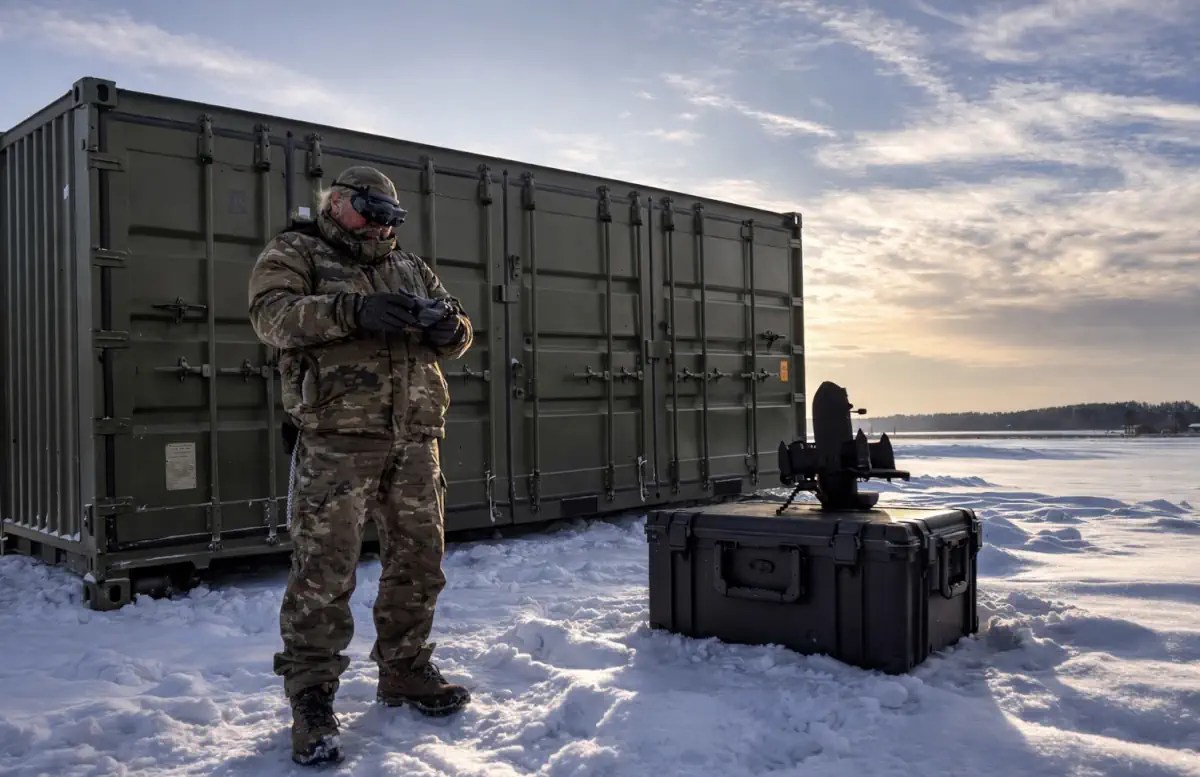
Sensofusion, the Finnish defense technology company, today announced the Tactical Drone Factory: a fully self-contained drone manufacturing facility built inside a standard shipping container. Equipped with industrial 3D printers, an electronics assembly station, and a complete parts inventory, a single Drone Factory can produce approximately 50 interceptor drones per day. The factory can be operated by a small team and deployed anywhere in the world.
The announcement comes as the wars in Ukraine and the broader Middle East have fundamentally rewritten the rules of air defense. In Ukraine, low-cost drones have reshaped the battlefield, forcing both sides into an accelerating cycle of innovation where today’s effective interceptor can be countered within weeks. In the Middle East, long-range drone threats have demonstrated that static defense infrastructure alone is insufficient. Across every theater, one lesson has become clear: the side that can adapt fastest wins.
Conventional defense manufacturing relies on large production runs and centralized warehousing. For most military hardware, this works. For drones, it does not. Drone technology evolves so rapidly that a design manufactured today may be tactically obsolete by the time it reaches the front line. Warehouses full of last quarter’s drones represent not just wasted capital, but a strategic vulnerability.
The Sensofusion Tactical Drone Factory (TDF) is a complete manufacturing facility compressed into a standard 20-foot shipping container (ISO 668, STANAG-compatible). Inside, a bank of industrial 3D printers produces carbon plastic airframes and structural components around the clock, while a dedicated manned assembly station handles electronics integration, motor installation, and final quality checks. Raw materials, spare parts, and tooling are stored on board.
Because the factory uses additive manufacturing, switching between drone designs requires only a new design plan. When intelligence identifies a new threat, operators can download an updated design and begin manufacturing immediately. This makes the Tactical Drone Factory not just a plant, but a platform for continuous adaptation.
“The lesson from Ukraine is that drone warfare is an evolutionary arms race, and the side that adapts fastest has the advantage,” said Mikko Hypponen, Chief Research Officer, Sensofusion. “You don’t want ten thousand drones sitting in a warehouse. You want to be able to build the drones that are needed when they are needed.”