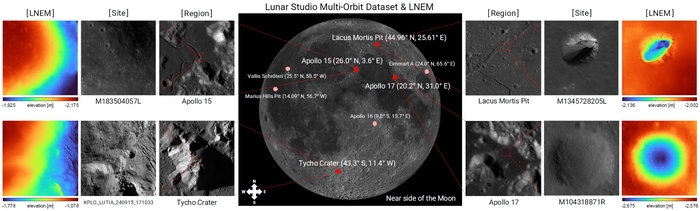
Researchers at the Korea Energy Engineering University (KENTECH) have developed a technology to precisely restore the three-dimensional topography of the moon's surface using artificial intelligence (AI), and have been recognized at the world's most prestigious computer vision conference.
The Korea Energy Technology University announced on the 17th that the AI-based Lunar Neural Elevation Model (LNEM), developed jointly by Professor Lee Seok-joo's research team with the Korea Aerospace Research Institute and the Korea Astronomy and Space Research Institute, has been adopted as a regular thesis for CVPR 2026, an international academic conference in the field of computer vision.
Recently, major space powers such as the United States, China, and Europe have competed for moon landing and resource exploration, increasing the importance of technology that precisely analyzes the surface of the moon. High-resolution topographic information is considered an essential technology for selecting a safe landing site for lunar landers, autonomous driving of rovers, and establishing resource exploration plans.
LNEM, developed by the research team, is a technology that restores the height and topography of the lunar surface in three dimensions based on images taken from actual lunar orbit. Previously, the method of comparing multiple images was mainly used, but there was a limit to the accuracy in areas with many shadows or unclear topographic features.
The research team applied neural rendering, the latest AI technology, using real images taken by NASA's Lunar Reconnaissance Orbiter (LRO) and Korea's first lunar orbiter Danuri (KPLO). In addition, a rigorous sensor model that reflects the probe's shooting environment was combined to enable high-accuracy topography restoration even in actual lunar exploration environments.
The research team also established a data processing platform called "Lunar Studio," which can integrate and utilize images taken by NASA LRO and Danuri. The platform is designed to make it easier for AI researchers to use lunar exploration data, which is expected to help revitalize related research in the future.