The Turkish public has recently come face to face with the darker, less visible side of unmanned systems employed in the war unfolding to the north of the Black Sea. One unmanned aerial vehicle (UAV) approaching from the Black Sea was neutralised in mid-air. Another, believed to have originated from the same direction, landed on Turkish territory. They did not cause damage. Official sources have so far made no statement regarding the identity of the first platform. The second, however, leaves little room for doubt at first glance: a Russian roundel is clearly visible on its wing, and the UAV has been identified as the Orlan-10.Does this information automatically place Russia in the role of the usual suspect”
The Orlan-10 typically carries only an intelligence, surveillance and reconnaissance (ISR) payload. With such a configuration, is it technically feasible for the platform to achieve a ferry range of 600 kilometres” In December weather conditions over the Black Sea, covering such a distance with this payload does not appear theoretically plausible.
With an operational range of approximately 120 kilometres, this UAV is also extremely difficult to detect on radar. This raises alternative possibilities. The platform may not have originated from deep over the Black Sea at all. It could have been launched from a ship nearby, a nearby littoral state—or even from within Türkiye. The presence of the roundel itself may have been a deliberate choice.
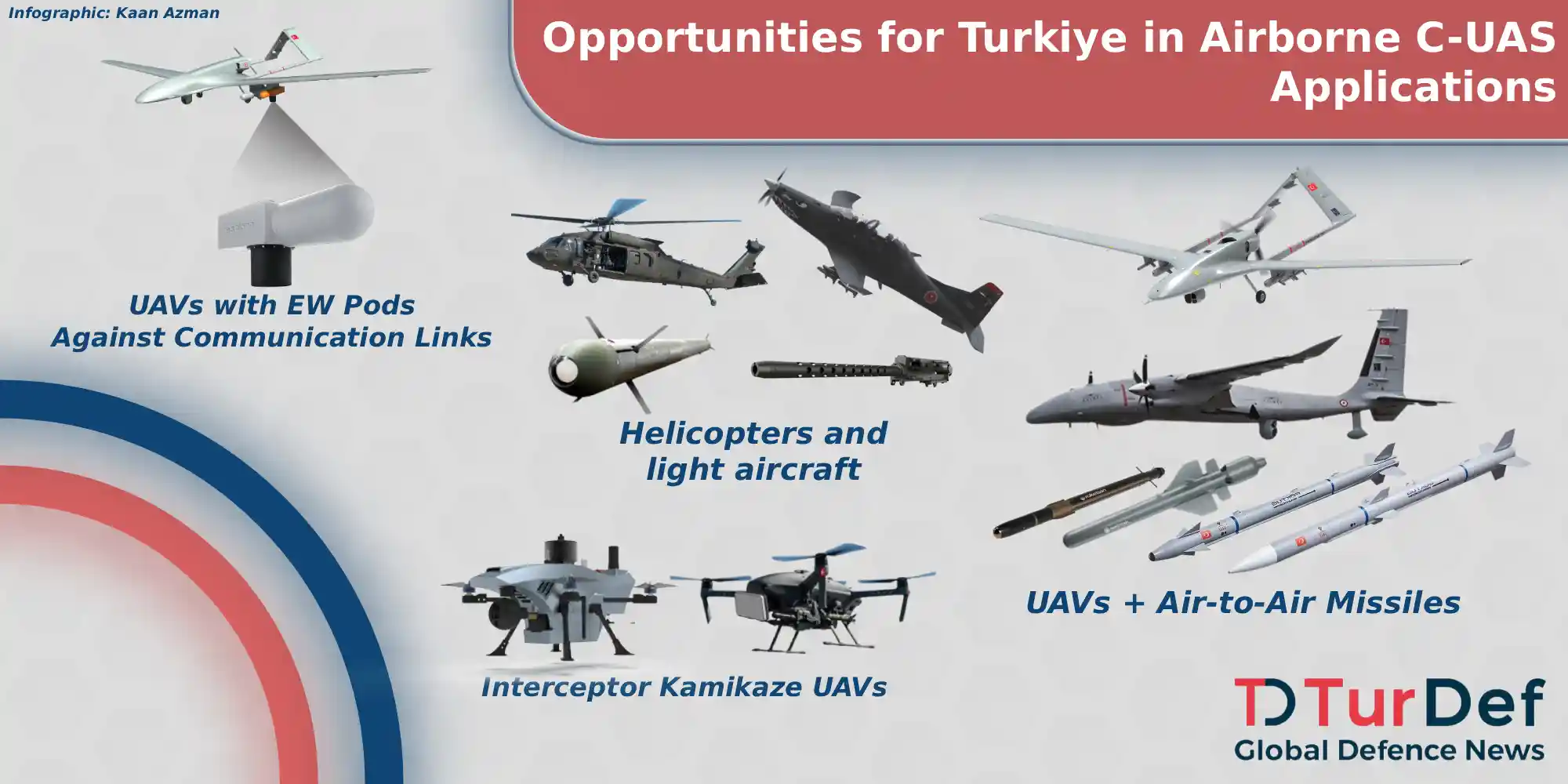
Two consecutive reports of UAV incursions into Turkiye’s airspace, with the first one being thoroughly monitored and ended in a way to preserve the civilians’ safety by TuAF F-16 fighters, it can be said that Turkiye might go for a new layer of defensive line that starts from the airspace for early detection, identification, and neutralisation as these incidents are less than likely to be the last.
While the Steel Dome IADS has a dedicated layer for C-UAS incorporating both soft-kill and hard-kill solutions, there are limitations to ground-based defence in terms of coverage and identification.
On the other hand, using the highly capable but expensive to operate and maintain fighter jets is not a sustainable approach when the potential regularity of the UAV incursions in the near future is considered.