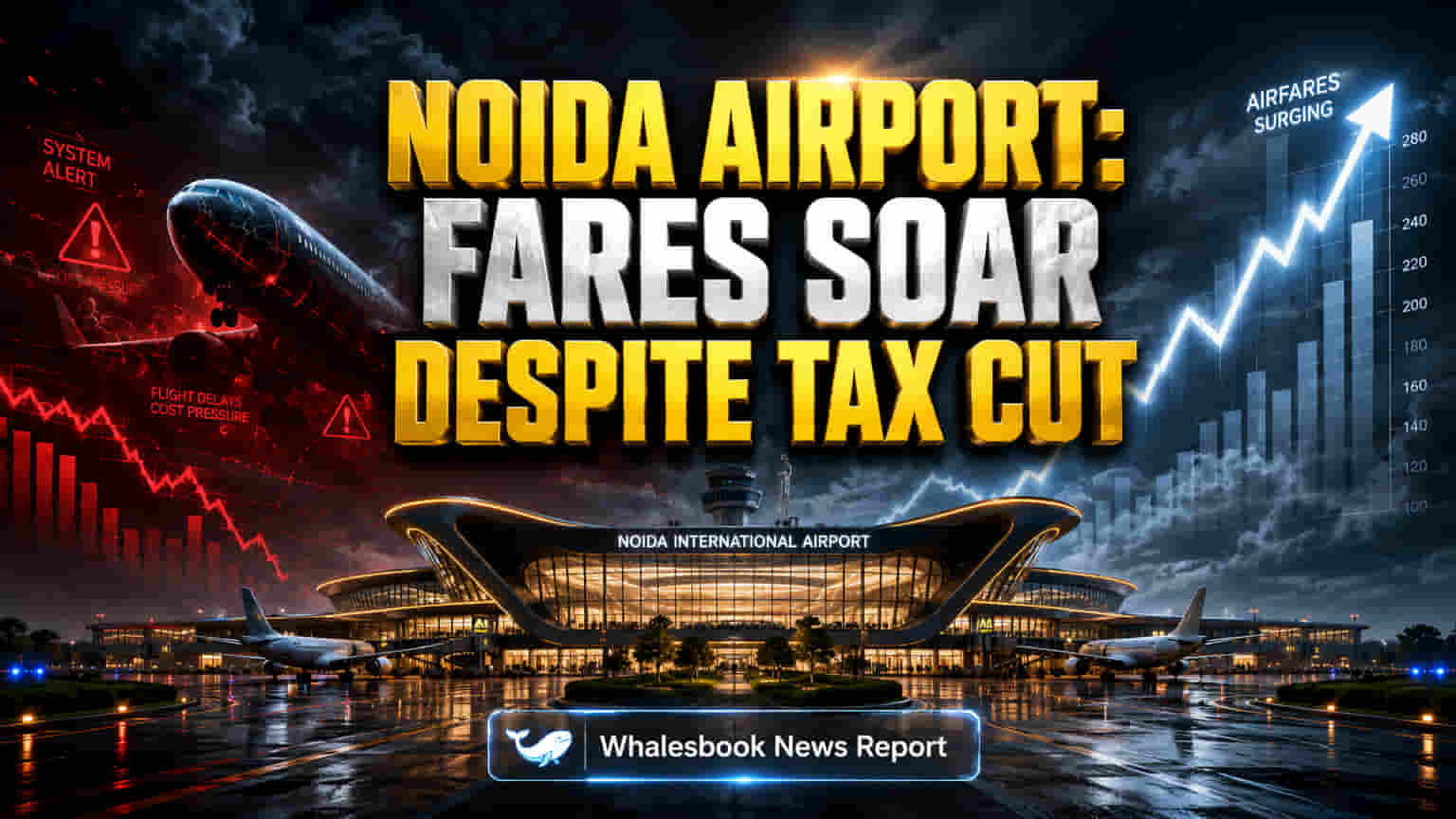
Noida Airport Faces Fare Parity With Delhi Amid Tariff RowTRANSPORTATIONAuthorRiya Kapoor|Published at:10th May 2026, 1:07 pmAdd as a PreferredSource on GoogleOverviewNoida International Airport (NIA), expected to launch soon, faces a pricing paradox. Despite Uttar Pradesh's low aviation fuel tax, high airport tariffs and passenger charges mean fares will likely match or exceed those from Delhi's Indira Gandhi International Airport (IGI). IndiGo has protested to aviation regulator AERA, warning these costs could deter passengers and hurt NIA's role in the National Capital Region. The airport operator argues its rates are competitive and necessary to recover major investments.
Commercial operations at Noida International Airport (NIA), set to begin imminently, are embroiled in a dispute over pricing. Airlines and officials worry that proposed airport tariffs and passenger fees will nullify Uttar Pradesh's advantage of a low 1% tax on aviation fuel (ATF). This contrasts sharply with Delhi's 25% VAT on ATF. Consequently, flight fares from NIA are expected to be the same as, or higher than, those from Delhi's Indira Gandhi International Airport (IGI). IndiGo, NIA's first airline, has formally complained to the Airports Economic Regulatory Authority (AERA). The carrier warns that higher charges will make fares more expensive than IGI's, potentially deterring passengers and undermining NIA's aim to serve the National Capital Region.
Noida International Airport's operator, Yamuna International Airport Private Limited (YIAPL), a unit of Zurich Airport International AG, defends its pricing. YIAPL states the proposed rates are comparable to those at similar new and existing airports nationwide. The operator explains the pricing aims to recoup substantial investments: approximately ?11,282 crore for Phase 1 and ?29,560 crore for the total project. Zurich Airport AG's 2025 financials showed CHF 1,361 million in revenue and CHF 346 million profit, reflecting significant investments like NIA. YIAPL argues that its focus on efficient operations keeps airline costs down, benefiting passengers, and that the tariff structure allows for longer-term investment recovery.
IndiGo has submitted detailed calculations to AERA, showing the financial impact of NIA's proposed fees. The airline claims landing charges for typical aircraft like the Airbus A320 and Boeing 737 are 119% higher for domestic and 53% higher for international flights at NIA compared to IGI. Domestic User Development Fees (UDF) are reportedly over 400% higher, with international traveller charges also rising significantly. IndiGo estimates one domestic round-trip on an Airbus A321 could cost ?1,88,000 more than at IGI. For 15 daily round-trip flights, this adds up to about ?103 crore annually compared to Delhi. IndiGo warns these high costs could make NIA commercially unviable for significant operations.
The Airports Economic Regulatory Authority (AERA) issued an interim tariff order to enable NIA's launch while it determines regular tariffs. Stakeholder meetings occurred in March 2026, with input due by April 17 for tariffs starting April 1, 2026. AERA had earlier proposed provisional UDFs of ?210 to ?980 in August 2025. The fare issue has also attracted political attention. The BJP MLA from Jewar has reportedly questioned the higher ticket prices and sought intervention from central and state leaders. This scrutiny highlights how airport pricing affects regional development and public perception.
NIA's Phase 1 will handle 12 million passengers annually, part of a ?29,560 crore master plan with Phase 1 costing ?11,282 crore. Delhi's IGI Airport, NIA's main competitor, is run by GMR Airports Infrastructure (GMRI). GMRI shares trade around ?101.32, with a negative P/E ratio of roughly -562.83, indicating recent losses. InterGlobe Aviation (IndiGo), India's largest airline by passengers, has a market cap of ?1.75 Trillion and a P/E ratio between 36.3 and 54.54. India's aviation sector is set for strong growth, projected to reach USD 45.59 billion by 2034 at an 11.72% annual growth rate (CAGR). Analysts view GMRI positively ('Strong Buy' consensus, target ?112.71), while IndiGo has a 'Moderate Buy' consensus but faces some concerns on earnings growth.