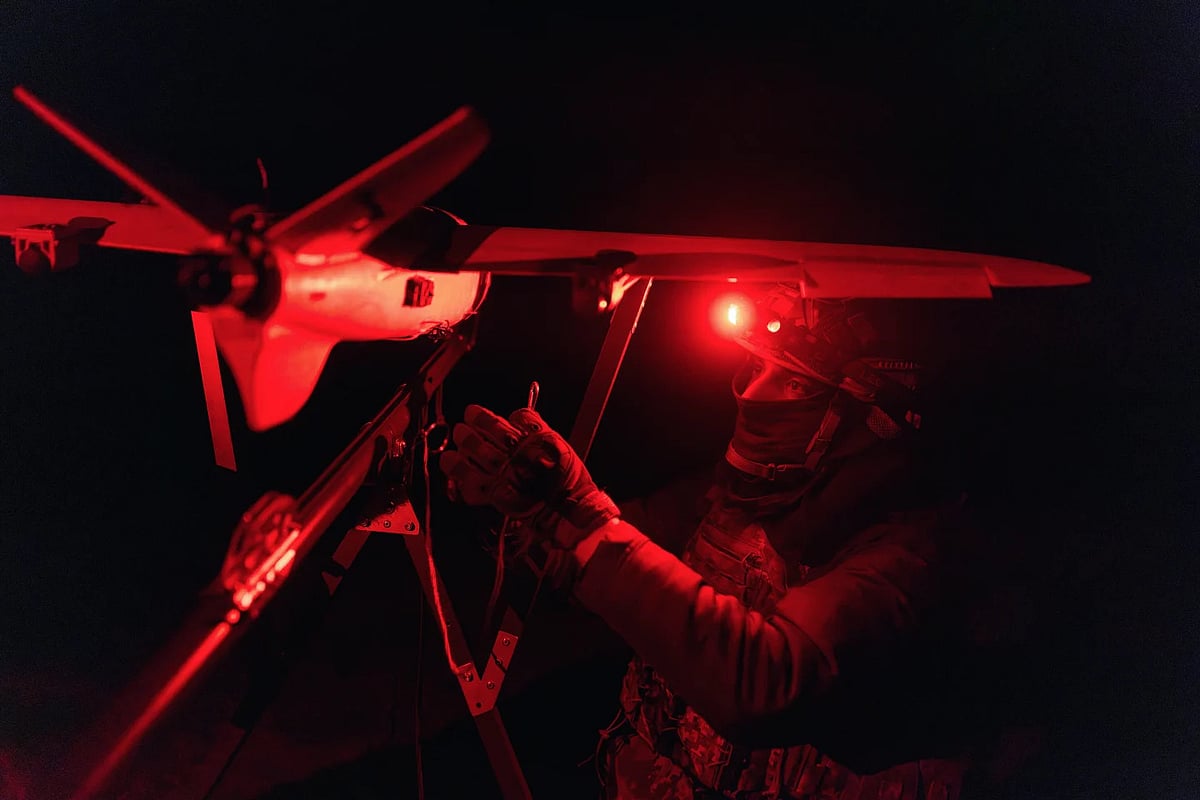
CopiedThe proliferation of drones in recent conflicts and their unmitigated use in all spheres of life has unwittingly projected them as a panacea for all ills. Maybe this would be a good time to not only discuss concepts and structures considered essential to develop unmanned forces in the country, but also to bust myths regarding their use.
At the outset, drones, at a conceptual level, are robots in the air. Robots are usually expected to proliferate in jobs that are dull, dirty and dangerous for humans. Since the battlefield is dangerous, it can be expected that unmanned systems will slowly replace humans in several dull tasks on the battlefield on land, and in sea and air. In Ukraine, logistics is almost entirely handled by unmanned ground systems. The bulk of offensive operations of the Ukrainian navy, too, are carried out by unmanned systems. This is a natural progression in the field of robotics. However, this needs further context on cost and effectiveness.
Every new weapon system enjoys a period of ?countermeasure holiday” when it is introduced, during which the existing counters are either ineffective or costly. The visible success of drones has been largely due to this.
But that phase is over. Sting, a $2,100 interceptor drone, has been in operation for over a year in Ukraine. President Volodymyr Zelenskyy offered it to the Gulf States recently. Similar systems are in production in several other countries, including India. Further, $1-per-shot lasers, high-power microwaves and other electronic warfare measures have been effective as well.
This doesn’t mean drones are going to be extinct. Like surface ships continue to exist after the arrival of submarines and aircraft, both drones and their countermeasures would co-exist. However, their recent performance cannot be linearly extrapolated.
While Operation Sindoor was the first time that saw the employment of one-way attack drones in India, it was actually inducted by the Indian Air Force way back in 1999. The IAF inducted the IAI Harpy, an unmanned anti-radiation hard-kill drone operationalised in the early 2000s. The much-talked-about Shahed-136 is designed and modelled on the Harpy. At the time, the existence of this system was not even known to the majority of IAF personnel. The IAF is the first among the forces to induct unmanned systems. It issued a vision for them in 2013, followed by the creation of a specialised branch of officers for them in 2022. The Unmanned Systems School has been operational for some time. The IAF has more than 27 years of institutional knowledge in operating unmanned systems in the air.
Published on 5/14/2026