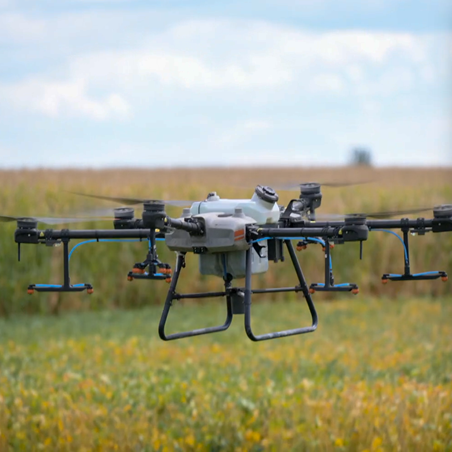
AMES — Drones are beginning to play a role in Iowa agriculture, particularly for crop monitoring and pesticide application, but most farmers remain uncertain about the technology’s advantages and limitations, according to results from the 2025 Iowa Farm and Rural Life Poll, an annual survey of Iowa farmers conducted by Iowa State University Extension and Outreach.
Aircraft have been used in farming for decades for tasks such as scouting, spraying and planting cover crops. Recent technological advances in unmanned aerial vehicles, commonly known as drones, have expanded their potential use in farm operations. As drones have become more affordable and easier to access, interest among farmers has grown. The 2025 farm poll included several questions designed to better understand how farmers are using drones and how they perceive the technology.
“As agricultural drone technology has improved, many opportunities to more efficiently scout for and treat pests and disease have emerged, and both farmers and drone service providers are taking advantage,” said J. Arbuckle, extension sociologist and director of the Iowa Farm and Rural Life Poll. “This year’s survey looked at how farmers are using drones and their attitudes toward them to better understand their information needs.”
Overall, 22% of surveyed farmers reported using a drone or a drone service provider in 2024. Among those who used drones, access most commonly came through specialized drone service providers (51%), followed by hiring an agricultural retailer or cooperative (37%). About one-quarter of drone users reported owning their own drone, while a smaller share rented or borrowed equipment.
The most common use of drones was monitoring and scouting crops, reported by 62% of drone users. Pesticide application was nearly as common, with 56% indicating this use. Fewer farmers reported using drones for planting (20%) or fertilizer application (9%).
Patterns of use differed depending on how farmers accessed drones. Farmers who owned or rented drones primarily used them for monitoring and scouting crops, with relatively limited use for spraying, planting or fertilizing. In contrast, farmers who hired drone services — either through cooperatives, agricultural retailers or specialized providers — most often used drones for pesticide application. Among these farmers, drone services accounted for a substantial share of their pesticide application work.