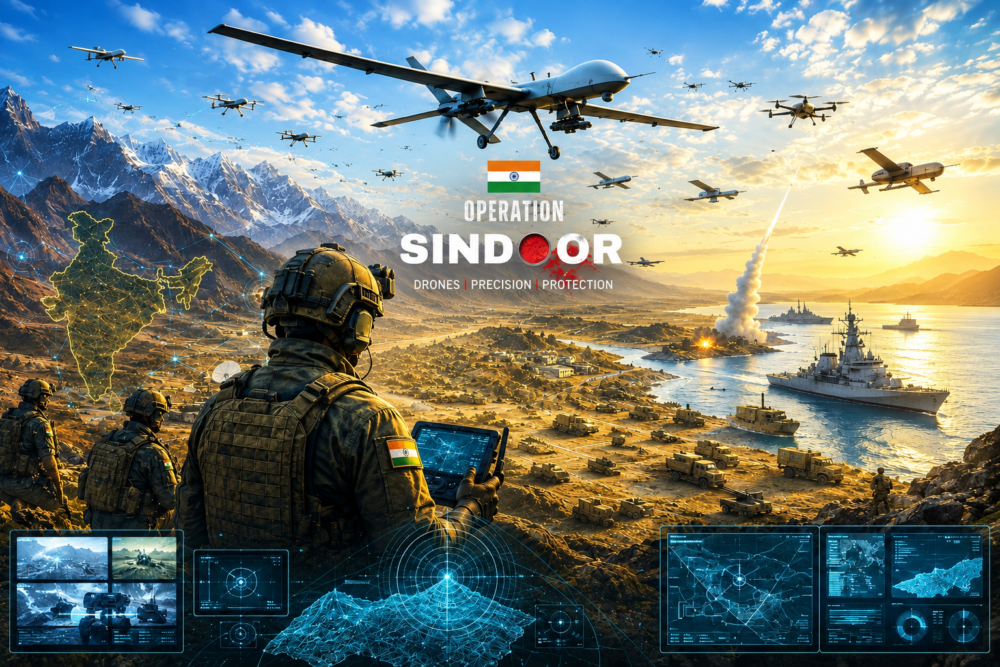
India’s drone capability remains fragmented. Individual procurements are increasing, but there is still no fully integrated national doctrine defining how drones should shape future warfare. This gap is increasingly dangerous. Drones must become integral components of military operations. Therefore, India requires a comprehensive National Military Drone Doctrine
The Drone Revolution: Nagorno-Karabakh to” Op Sindoor:“In 2020, the world witnessed a war between Azerbaijan and Armenia, which marked a turning point in military history. Azerbaijan’s extensive use of Turkish Bayraktar TB2 drones and Israeli loitering munitions systematically destroyed Armenian tanks, artillery, radar systems, and logistics infrastructure, exposing the vulnerability of traditional battlefield formations against low-cost unmanned systems.
If Nagorno-Karabakh announced the arrival of drone warfare, the Russia-Ukraine conflict institutionalised it as the defining face of modern warfare. FPV suicide drones, swarm attacks, maritime drones, and AI-assisted targeting transformed warfare into a transparent and highly attritional battlefield where concealment became increasingly difficult. Simultaneously, conflicts involving Iran, Israel, and regional proxy militia groups demonstrated how drones could become tools of asymmetric warfare and strategic coercion. These wars collectively proved that future military superiority will depend not only on expensive platforms like tanks and fighter aircraft, but increasingly on the ability to mass-produce intelligent, expendable, and networked unmanned systems, rapidly and at scale.
India’s understanding of drone warfare has undergone a dramatic transformation in recent years, particularly after Operation Sindoor demonstrated that drones are no longer auxiliary support systems but decisive battlefield assets.
Modern drone warfare now encompasses an entire ecosystem of technologies, including ISR platforms for surveillance and reconnaissance, FPV attack drones for precision strikes, loitering munitions capable of autonomous targeting, swarm drones designed to overwhelm defences, and AI-enabled systems integrated with electronic warfare networks.
For India, this evolution carries immense strategic significance. Facing persistent border tensions, hybrid warfare threats, infiltration challenges, and rapidly evolving battlefield technologies, India can no longer rely solely upon conventional military structures designed around tanks, artillery, and fighter aircraft. Instead, future warfare will increasingly depend on interconnected networks that combine drones, satellites, artificial intelligence, sensors, cyber capabilities, and electronic warfare into a single integrated combat architecture. India has, therefore, begun moving towards drone-equipped formations, indigenous unmanned systems, and enhanced surveillance capabilities across critical sectors. However, the real challenge lies not merely in acquiring drones but in building a comprehensive unmanned warfare ecosystem encompassing doctrine, manufacturing, command integration, electronic resilience, and rapid innovation that can continuously adapt to future battlefield realities.
Published on 5/11/2026