Share full articleOne of the biggest takeaways of the war with Iran is that it has proven itself to be a surprisingly capable adversary against the United States. In addition to its willingness to go on the offensive, Iran has forced the U.S. and its regional allies to confront the rise of cheap drones on the battlefield.
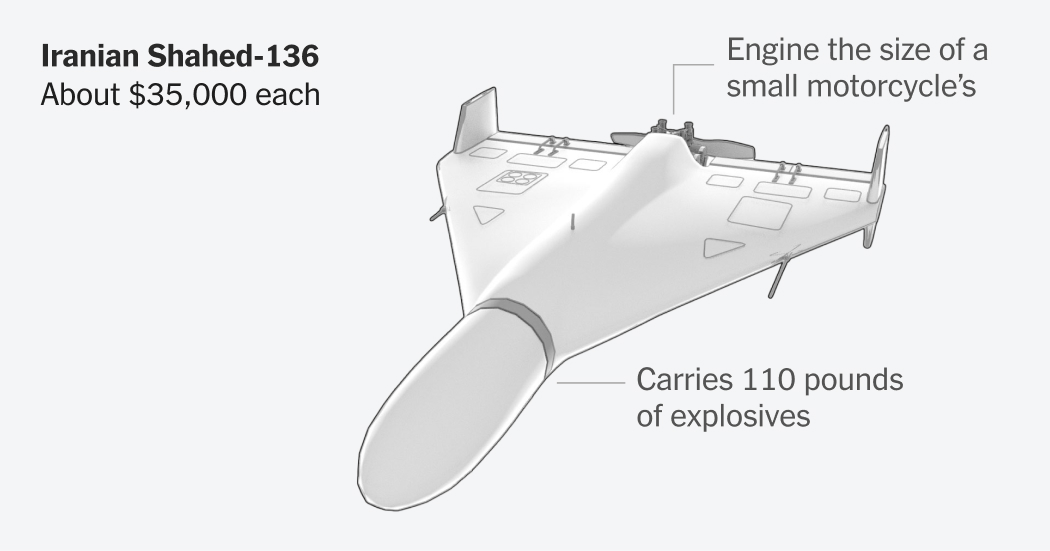
Iranian drones, made with commercial-grade technology, cost roughly $35,000 to produce. That is a fraction of the cost of the high-tech military interceptors sometimes used to shoot them down.
Note: Estimated price of munitions per unit. In practice, multiple interceptors are fired when targeting a drone. For instance, with the $80 bullet fired by the Centurion Counter-Rocket, Artillery, and Mortar (C-RAM), 75 rounds are fired in a second. Sources: Department of Defense, Lockheed Martin, Northrop Grumman, Open Source Munitions Portal, SRC Inc, U.S. Army and U.S. Navy.
Cheap drones changed the war in Ukraine, and they have enabled Iranians to exploit a gap in American defense investments, which have historically prioritized accurate but expensive solutions.
Countering drones has been a major priority for the Pentagon for years, according to Michael C. Horowitz, who was a Pentagon official in the Biden administration. “But there has not been the impetus to scale a solution,” he said.
In just the first six days, the U.S. spent $11.3 billion on the war with Iran. The White House and Pentagon have not provided updated estimates, but the American Enterprise Institute, a conservative-leaning think tank, estimated in early April that the U.S. had spent approximately between $25 and $35 billion on the war, with interceptors driving much of the cost. Many missile defense experts also fear interceptor stockpiles are now running dangerously low.