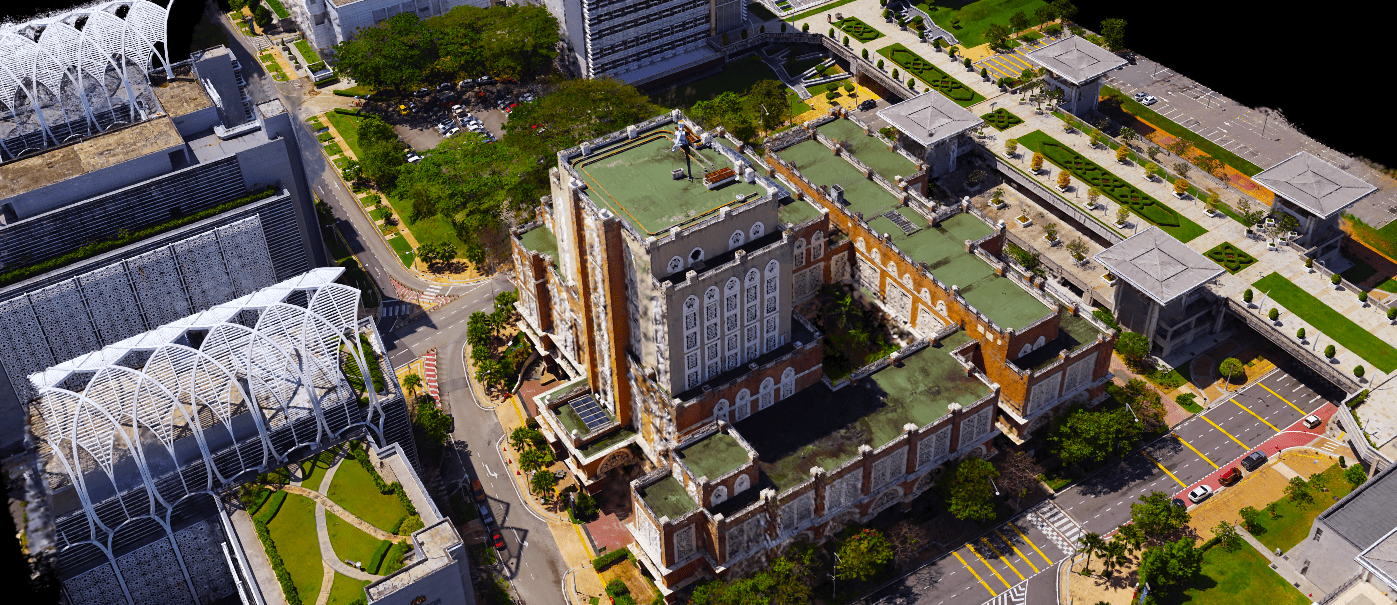
Gaussian splatting has quickly become one of the most talked-about developments in 3D reconstruction. Known for its ability to create highly realistic, smooth-rendered scenes, the technique has sparked a central question across the geospatial industry: can it move beyond visualization and support real-world mapping workflows”
Gaussian splatting represents 3D environments using dense collections of Gaussian primitives, producing continuous surfaces that often appear more natural than traditional mesh-based models. The results can be visually striking, particularly in complex environments where texture and depth perception matter.
In Correlator3D Version 11, this capability is now part of the core workflow. Users can generate splat-based models directly from imagery and work with them alongside standard photogrammetry outputs.
SimActive says the goal is to provide high-quality 3D visualization without disrupting established production pipelines. “Our team has integrated Gaussian splatting natively into Correlator3D,” said CTO Louis Simard. “Version 11 gives users a practical way to produce high-quality 3D content with stunning visual fidelity while maintaining full control within a familiar photogrammetric environment.”
Gaussian splatting excels at creating immersive, visually complete scenes. It can present environments in a way that is intuitive and easy to interpret, even when underlying data may be uneven or incomplete.
Photogrammetry, however, is designed for precision. It delivers georeferenced datasets, consistent geometry, and outputs that support engineering, surveying, and GIS applications. These characteristics remain essential for workflows where decisions depend on reliable measurements.
Published on 5/14/2026