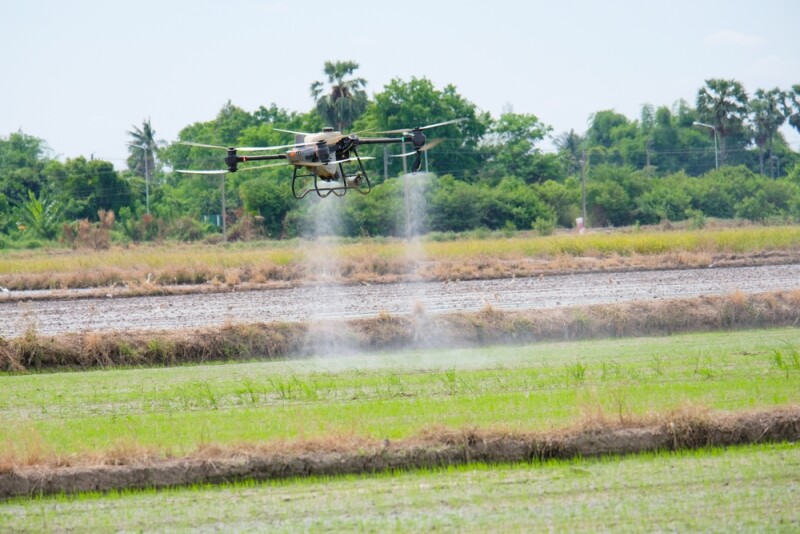
Commercial UAVs are most often framed as delivery systems – platforms designed to move inputs efficiently from tank to canopy. While this framing has helped drive adoption, it also limits how value is understood and captured. Field evidence increasingly shows that the long-term impact of agricultural UAVs lies not in spraying alone, but in how data transforms these systems into decision-support tools for climate-smart agriculture.
Yet in many commercial deployments, this data remains underutilized. Spraying decisions are often based on heuristics, default settings, or vendor recommendations rather than evidence derived from previous missions.
Field-level studies combining spraying performance data with machine learning models revealed strong non-linear relationships between operational parameters and efficiency outcomes.
This approach replaces trial-and-error optimization with predictive decision support, allowing operators to select mission parameters before takeoff rather than correcting inefficiencies after the fact.
Climate-smart agriculture is often discussed at policy or landscape scales. UAV data enables climate intelligence to emerge at the operational level, where daily decisions are made.
Operators who rely solely on hardware performance are vulnerable to variability caused by weather, crop differences, and terrain. Those who integrate data-driven decision frameworks build resilience into their operations, reducing risk and improving consistency.