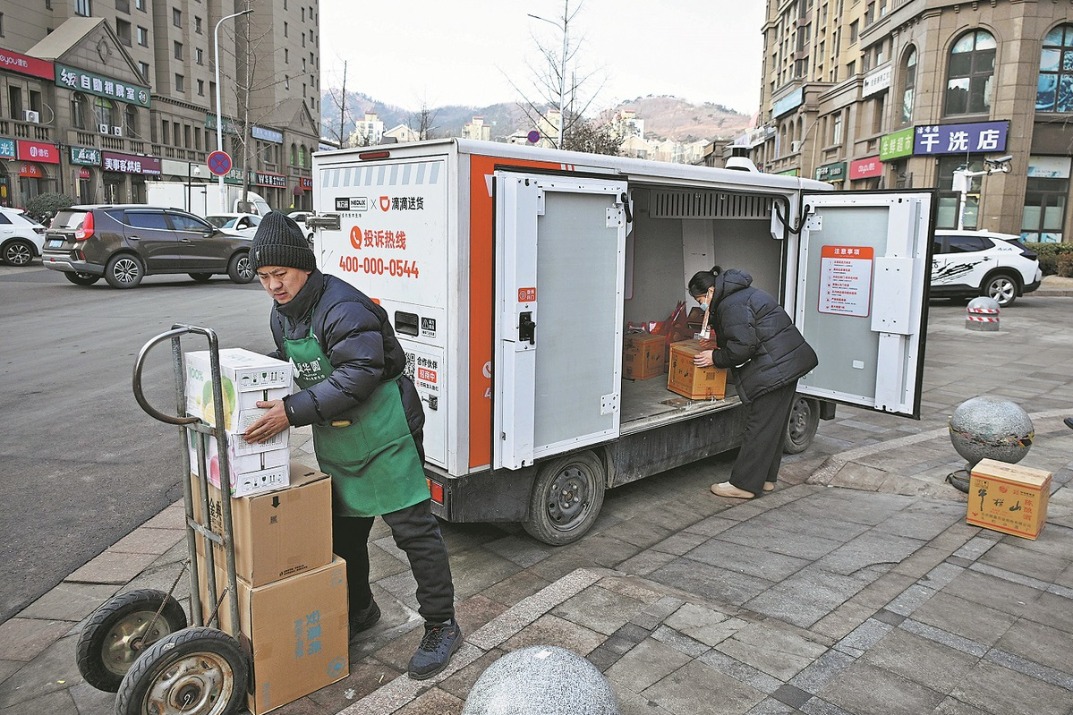
An unmanned delivery vehicle pulled up in front of Zhou Li, a resident in Qingdao, East China's Shandong province. After scanning the QR code on its side, she collected her order — beer, sausage and roasted nuts — before the vehicle quietly drove away on its own.
In the coastal city of Qingdao, autonomous delivery vehicles are now a familiar sight on the streets. With no driver's section or steering wheel, the boxy vehicles resemble compact metal containers, measuring roughly half the size of a standard passenger car. Powered by artificial intelligence, the vehicle can plan routes, recognize road conditions, detect traffic lights and nearby obstacles, and brake or maneuver to avoid collisions.
So far, unmanned delivery vehicles in China handle major tasks such as transporting packages from distribution hubs to local nodes and providing on-time delivery of perishable goods and cold-chain medicines. Some are also used in logistics within industrial parks.
Qingdao is now home to roughly 1,150 unmanned delivery vehicles, making it one of China's largest application sites. Neolix, a leading domestic player in this sector, holds a significant share of the fleet.
In June 2025, the company began piloting the unmanned delivery service in the eastern port city. Currently, vehicles running there have a load-bearing capacity of one metric ton, a cargo space of six cubic meters, a top speed of 45 kilometers per hour, and a battery range of 200 km.
Since 2021, Neolix has been developing AI-based vision algorithms that enable its vehicles to interpret complex traffic conditions with the judgment of an experienced driver, thus significantly cutting the cost of map collection and updates, according to Miao Qiankun, the company's chief technology officer.