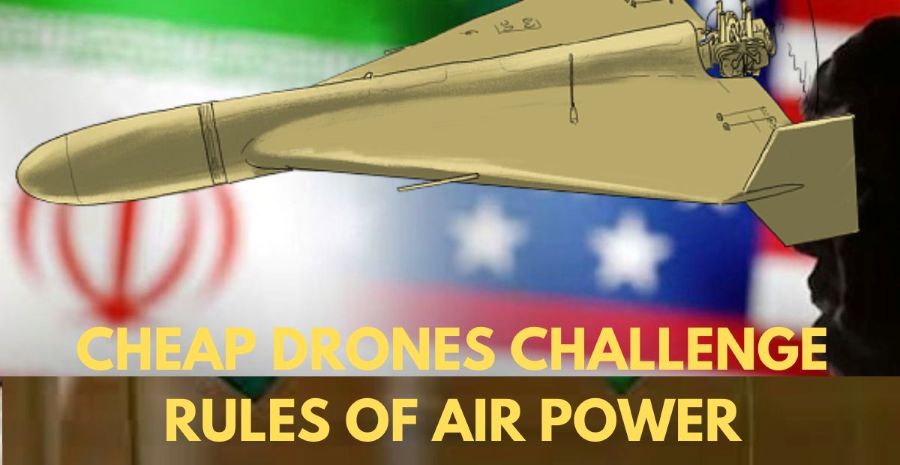
For decades, control of the skies largely belonged to wealthy militaries able to afford sophisticated fighter aircraft, complex air-defence systems, and the training needed to operate them. That advantage is now being challenged by a far cheaper weapon: the attack drone.
Across multiple conflicts, from Ukraine’s battlefield with Russia to Iran’s escalating confrontation with the United States and Israel, large numbers of inexpensive unmanned aircraft are reshaping the character of modern warfare.
The shift is not about technological superiority but scale. Cheap drones launched in large numbers are proving capable of overwhelming even the most sophisticated air-defence networks, forcing militaries to confront an uncomfortable reality: attacking the skies has become far cheaper than defending them.
Since the United States and Israel carried out strikes on Iran on February 28, Tehran has launched hundreds of missiles and more than a thousand drones against Israel and several Gulf states aligned with Washington. The strategy relies less on precision strikes and more on saturation, large waves of drones and missiles designed to exhaust air defences.
According to the Institute for National Security Studies” Data Analytics Centre in Israel, Iran launched 227 waves of attacks on Israel between February 28 and March 15, including over 290 ballistic missiles and about 500 drones.
Gulf states have also faced heavy barrages. No country has been hit harder than the United Arab Emirates, which by mid-March had been targeted with an estimated 309 missiles and roughly 1,600 drones.