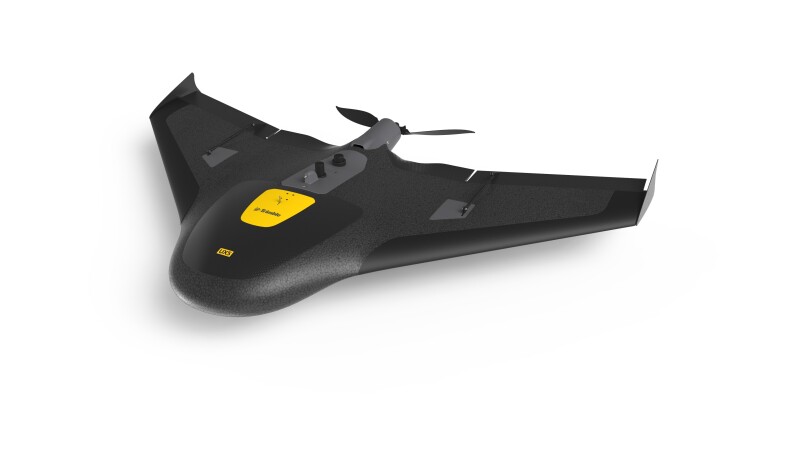
On May 26, 2013, I saw my first drone. It was not the traditional multicopter that a lot of people were beginning to use for photography and having fun at the beach or in the backyard. Instead, this drone was a fixed-wing black beauty made in Belgium and designed specifically for aerial photogrammetry, my profession. It was called the UX5, and I was responsible for selling it in Latin America as part of my duties (and my quota!) as Sales Manager LATAM for Trimble Navigation, which later changed its name to Trimble Inc.
The story of the UX5 is, at its core, the story of how a small Belgian startup helped pull a global geospatial giant into the age of unmanned aviation. Gatewing, founded in Ghent at the dawn of the 2010s drone boom, was one of the first companies to recognize that fixed’wing UAVs could become precision tools for mapping rather than toys for hobbyists. Its engineers built the X100 and later the UX5, lightweight, foam’bodied aircraft that could autonomously fly photogrammetric survey missions with a level of repeatability and reliability that was rare at the time.
What Gatewing lacked in scale, it made up for in technical clarity. The company understood that the future of surveying would be a fusion of sensors, flight automation, and data processing. That clarity caught Trimble’s attention. Trimble was expanding aggressively beyond GPS receivers into full’stack geospatial solutions. Acquiring Gatewing gave Trimble an instant foothold in professional UAVs, along with a talented Belgian engineering team that had already solved many of the early problems of fixed’wing mapping drones.
Under Trimble, the UX5 matured into a polished commercial product, integrated tightly with Trimble’s surveying ecosystem and sold globally under the Trimble brand. But by 2016, the drone landscape had shifted. Hardware was becoming commoditized, regulatory complexity was rising, and Trimble’s long’term strategy was tilting toward software, analytics, and workflow integration rather than inhouse aircraft manufacturing.
In October of that year, Trimble divested the entire Belgian UAS business Gatewing’s people, IP, and product lines, to Delair, a French company specializing in long’range fixed’wing drones. The move allowed Trimble to step back from hardware while still partnering with Delair and others for UAV data capture. For Delair, the acquisition provided a proven platform and a seasoned engineering team. And for the UX5, it was the continuation of a uniquely European lineage that began in a Belgian startup and ultimately helped shape the early professional drone market.
I feel somewhat responsible for the divestiture of the UX5 lineage to Delair because our success in selling the aircraft in Latin America showed the ugly underbelly of the aviation business. Airplanes fall from the skies, and when that happens, everyone, beginning with the pilot (if they are still alive) and the operator, begin searching for answers, and in most cases for someone to blame.